Currently accepting new patients
Address

‍
2007 Medical Pkwy, Suite B
San Marcos, TX 78666
Get Directions

Office hours

Mon - Friday: 8AM – 5PM
Weekends:
Closed

Phone

Phone: (512) 298-1645

Fax: (512) 298-1795

Accepted insurance

- Aetna
- Blue Cross/Blue Shield (BCBS)
- Champ VA
- Cigna
- CMS
- Connected Senior Care Alliance
- Friday
- GEHA
- Humana
- Medicare
- Multiplan
- Oscar
- Railroad Medicare
- Smarthealth
- Tricare
- Triwest
- United Healthcare
- WellMed
- Worker's Compensation
- Private Pay

What Is Rheumatoid Arthritis?

Rheumatoid arthritis is a chronic autoimmune disorder that primarily affects the joints but can also involve other tissues and organs throughout the body. Unlike osteoarthritis, which develops from wear and tear over time, rheumatoid arthritis occurs when the immune system mistakenly attacks healthy tissue. This immune response leads to ongoing inflammation, pain, swelling, and joint damage.

Rheumatoid arthritis is considered a rheumatic disease and often requires long-term management. Without treatment, the condition can progress, potentially leading to joint deformity, reduced mobility, and disability. Early diagnosis and a structured treatment plan are important for protecting joint health and preserving quality of life.

At Greater Austin Pain Center, our board-certified physicians and pain management specialists work closely with patients to provide comprehensive care tailored to each individual. Our San Marcos, TX clinic is currently accepting new patients.

Doctor in white coat examining hand X-rays at a medical office desk.

How Rheumatoid Arthritis Affects the Body

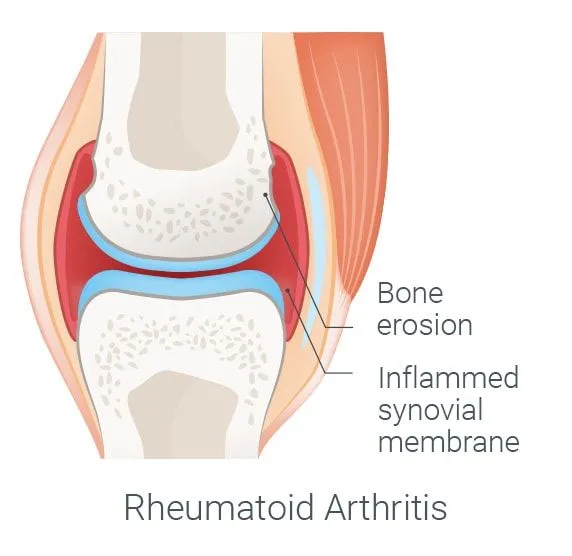
Rheumatoid arthritis affects the body differently than other forms of arthritis. The immune system targets the synovial lining of affected joints, causing inflammation that can damage cartilage, bones, muscles, and connective tissues. Over time, this process may lead to joint erosion, instability, and reduced range of motion.

Beyond the joints, rheumatoid arthritis can affect other systems. In some patients, inflammation may involve the lungs, skin, blood vessels, or eyes. Rheumatoid nodules can develop under the skin, and related autoimmune conditions such as Sjogren's syndrome or lupus may occur alongside rheumatoid arthritis.

Symptoms may vary from person to person and often develop gradually. Common signs include:

  • Persistent joint pain and swelling
  • Morning stiffness lasting longer than an hour
  • Redness and warmth around affected joints
  • Fatigue and reduced energy levels
  • Difficulty performing daily activities
  • Involvement of multiple joints, often symmetrically on both sides of the body

Hands, wrists, knees, and feet are commonly involved, though larger joints may also be affected. Symptoms can persist even during rest and may worsen over time without treatment.

Causes and Risk Factors for Rheumatoid Arthritis

Rheumatoid arthritis develops due to a combination of factors rather than a single cause. Contributing factors may include:

  • Immune system dysfunction that triggers an autoimmune response
  • Genetic predisposition that increases susceptibility
  • Environmental factors that may activate the disease
  • Inflammatory processes that damage joints and surrounding tissues
  • Smoking
  • Overweight and obesity
  • Prior joint injuries

While aging and mechanical wear contribute to conditions like osteoarthritis, rheumatoid arthritis can develop in adults across a wide range of ages, including younger individuals. In some cases, a related juvenile form of the disease can affect children as well.

Understanding whether symptoms reflect an autoimmune process or another cause is essential for accurate diagnosis. The specialists at Greater Austin Pain Center, serving patients in San Marcos, TX and the broader Austin area, can help evaluate your symptoms and guide you toward appropriate care.

Diagram of rheumatoid arthritis in a knee joint showing bone erosion and inflamed synovial membrane.

Rheumatoid Arthritis Treatment Options at Greater Austin Pain Center

Treating rheumatoid arthritis focuses on managing inflammation, relieving pain, and slowing disease progression. At Greater Austin Pain Center, treatment plans are personalized based on symptoms, disease severity, and overall health goals.

Non-Surgical Approaches

Most patients benefit from conservative, non-surgical strategies as the foundation of their care. These may include medications to reduce inflammation and control the immune response, pain management strategies to improve daily comfort, and lifestyle guidance to reduce joint stress. Your care team may also coordinate a referral to a physical therapist to help maintain joint mobility and muscle strength alongside your pain management plan.

Joint Injections

Joint Injections may be recommended to reduce inflammation and pain in specific joints, including the knees, hips, shoulders, ankles, or sacroiliac joint. Injections can offer targeted relief for patients whose symptoms are concentrated in one or a few areas.

Platelet Rich Plasma

Platelet Rich Plasma (PRP) injections use components drawn from a patient's own blood to support healing and help reduce inflammation in affected joints. PRP is part of GAPC's broader approach to regenerative care.

Viscosupplementation Treatment

For certain patients, Viscosupplementation Treatment injections may help improve joint lubrication, particularly in the knees, to ease movement and reduce discomfort.

Every treatment plan at our San Marcos location is developed with the individual patient in mind. Your provider will review your full clinical picture before recommending any specific approach.

Modern waiting room at Greater Austin Pain Center with chairs and reception desk

Getting Care for Rheumatoid Arthritis at GAPC

1

Step 1: Schedule an Appointment

The first step is contacting Greater Austin Pain Center to request an appointment at our San Marcos, TX clinic or another Central Texas location that is convenient for you. Our team will gather some basic information about your symptoms and insurance coverage so your first visit can be as productive as possible.

2

Step 2: Evaluation and Diagnosis

At your initial visit, one of our board-certified providers will conduct a thorough physical examination and review your medical history. This evaluation may include blood tests and imaging studies to assess joint inflammation and damage, helping to clarify whether rheumatoid arthritis or another condition is contributing to your symptoms.

3

Step 3: Your Personalized Treatment Plan

Based on your evaluation findings, your provider will develop a treatment plan tailored to the severity of your symptoms, your overall health, and your daily needs. This plan may include targeted injections, regenerative options, medication management coordination, and referrals to complementary providers such as physical therapists when appropriate.

4

Step 4: Ongoing Care and Follow-Up

Rheumatoid arthritis is a chronic condition that benefits from consistent, long-term management. Your care team will schedule follow-up appointments to monitor your progress, adjust your treatment plan as needed, and help you maintain the best possible joint function and quality of life over time.

Testimonials

5 gold stars

"Dr. Jarzembeck is AMAZING. I HIGHLY recommend her for anyone suffering in pain. She goes above and beyond to make sure her patients pain has been dealt with."

Genia G.
5 gold stars

"Everyone is so friendly and helpful, Dr. Bednar came to me and explained the procedure and answered my questions. Highly recommend!"

Maggie G.
5 gold stars

"Dr. Julia is the best! The staff is professional and friendly to all. Best of all, Dr. Julia is finding solutions for my chronic pain! Never thought that it would be possible. It's a journey for me, but it seems like there is a solution."

Nancy M.

Frequently Asked Questions

How is rheumatoid arthritis diagnosed?

arrow icon

Diagnosis involves a physical examination, a review of medical history, blood tests to look for markers of autoimmune activity and inflammation, and imaging studies to assess the extent of joint damage.

How is rheumatoid arthritis different from osteoarthritis?

arrow icon

Rheumatoid arthritis is an autoimmune disease in which the immune system attacks healthy joint tissue, causing inflammation. Osteoarthritis results from mechanical wear and gradual cartilage breakdown over time. Understanding the difference is essential for choosing the right treatment approach.

Can rheumatoid arthritis affect organs other than joints?

arrow icon

Yes. In some patients, rheumatoid arthritis may involve other systems, including the lungs, skin, blood vessels, or eyes. Rheumatoid nodules can also develop under the skin.

Is rheumatoid arthritis a lifelong condition?

arrow icon

Rheumatoid arthritis is chronic, meaning it typically requires ongoing management. However, early diagnosis and a structured treatment plan can help manage symptoms and may slow disease progression over time.

Can younger adults or children develop rheumatoid arthritis?

arrow icon

Yes. Unlike osteoarthritis, which is associated primarily with aging, rheumatoid arthritis can develop in adults across a wide range of ages, including younger individuals. A related condition can also affect children in some cases.

What types of injections or minimally invasive treatments may help with rheumatoid arthritis?

arrow icon

Depending on the joints involved and the severity of symptoms, a provider may recommend joint injections to reduce localized inflammation, platelet rich plasma (PRP) injections to support the healing process, or viscosupplementation injections to improve joint lubrication. Treatment recommendations are always individualized based on a thorough evaluation.

Lunch & Learn With Our Doctors

Curious about interventional pain treatments in Austin, TX? Join our doctors for an in-person lunch and learn session to find out more about these treatments and ask any questions you may have. This event will be 12–1pm, sign up below to receive more details and RSVP.

Loading security check...

Thank you! Your submission has been received!
Oops! Something went wrong while submitting the form.

Find Rheumatoid Arthritis Care Near San Marcos, TX

If you are dealing with joint pain, swelling, or stiffness that has not improved on its own, the team at Greater Austin Pain Center is ready to help. With offices in Austin, Kyle, Dripping Springs, and right here in San Marcos, our Texas-based pain specialists are accessible to patients throughout the Central Texas region. Contact us today at (512) 298-1645 to schedule a consultation and take the next step toward better joint health.

Schedule an Appointment

Relieve Your Pain Today!
Disclaimer: Using this form does not establish a patient-physician relationship. This form is not to be used for emergencies or urgent requests. Please call 911 if you have a life-threatening emergency.
By submitting this form you agree to the collection of your personal data pursuant to our privacy policy.

Loading security check...

Green padlock icon
All Information Is Secure and Confidential
Thank you! Your submission has been received!
Oops! Something went wrong while submitting the form.
A modern medical office waiting room with gray chairs, small tables with plants and brochures, wood-style flooring, and a reception desk. The wall displays the sign "Greater Austin Pain Center."

Greater Austin Pain Center Is Hiring! Apply Online Today